
Indian benchmark indices, Sensex and Nifty, experienced declines in early trade due to a surge in crude oil prices and significant selling pressure on bank stocks, impacting overall investor sentiment. Track Sensex, Nifty on July 22.

The combined market valuation of four of India's top-10 most valued firms eroded by Rs 87,960.29 crore last week, with Bharti Airtel experiencing the largest decline, amidst a bearish trend in the equities market.

For over a decade, HDFC Bank consistently outperformed industry growth rates in both deposits and advances, maintaining impeccable asset quality. Amid a landscape where other banks struggled with soaring non-performing assets (NPAs), HDFC Bank thrived, eventually surpassing ICICI Bank to become the largest private sector lender in India. Its net interest margin (NIM) remained stable in the range of 4.1-4.4 per cent.
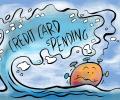
Credit card spending in India has consistently topped Rs 2 trillion for three consecutive months, with July 2026 recording Rs 2.08 trillion, indicating a new normal for consumer expenditure, according to the latest RBI data.
ICICI Bank, India's second-largest private-sector lender, is set to raise approximately $500 million through an overseas dollar bond issuance, marking its first such move in nearly a decade. This fundraising effort will utilise the Reserve Bank of India's (RBI) concessional swap window, a facility designed to reduce hedging costs for foreign currency borrowings.

The combined market valuation of five of India's top-10 most valued firms eroded by Rs 1 lakh crore last week, with IT giant Tata Consultancy Services (TCS) experiencing the largest decline amidst a bearish trend in domestic equities.

Among Sensex shares, Infosys, Tata Consultancy Services, Tech Mahindra, Sun Pharmaceutical, Bajaj Finserv, HCL Technologies, Bajaj Finance, HDFC Bank, IndusInd Bank and Kotak Mahindra Bank were among the gainers. Tata Motors, PowerGrid, Axis Bank, State Bank of India, NTPC, Tata Steel and Adani Ports were the major laggards.

Indian stock markets, including the Sensex and Nifty, experienced their third consecutive day of declines, driven by a global selloff, escalating tensions in West Asia, and a subsequent rise in crude oil prices.

The benchmark BSE Sensex rebounded by 362 points, ending a four-day losing streak, driven by strong buying in metal, private banking, and oil and gas shares, while the broader NSE Nifty saw modest gains despite paring some advances in the closing session.
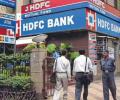
The merger of housing finance major HDFC with the country's largest private lender HDFC Bank will be effective from July 1, HDFC chairman Deepak Parekh said on Tuesday. The boards of HDFC and the private bank will meet on June 30 post to clear and approve the merger, Parekh told reporters in Mumbai. The merger of the corporation with HDFC Bank will be effective July 1, Parekh said.
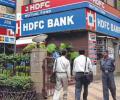
But there are challenges, observes Tamal Bandyopadhyay.

The asymmetry in deposit and credit growth is the biggest challenge before the Indian banking industry. For every 100 deposit that a bank mobilises, it needs to keep 3 with the banking regulator in the form of cash reserve ratio on which it doesn't earn any interest. Another 18 is used for buying government bonds (statutory liquidity ratio). This means, a bank is left with 79 for giving credit. Add to this, its capital which can be used for giving loans. Most banks are facing a fund crunch. They need to find ways to attract deposits if they want to sustain credit growth, explains Tamal Bandyopadhyay.

The Reserve Bank of India (RBI) has introduced a new framework allowing banks to offer differential interest rates on bulk deposits based on their liquidity characteristics under the Liquidity Coverage Ratio (LCR) framework, while maintaining the principle of uniform pricing across similar deposits.
In a mixed bag for HDFC Bank ahead of the parent HDFC's merger with itself, the Reserve Bank of India has declined to make exceptions on certain aspects, and has offered some leeway on others. The country's largest private sector lender, which is aiming to conclude the merger with the home finance major by July, had written to the central bank seeking certain forbearances after announcing the $40-billion merger in April last year. In an exchange filing this evening, HDFC Bank said it received a response from RBI on Thursday and also said that there are a few pending issues.

Indian benchmark indices Sensex and Nifty recorded sharp gains, rising over 1 per cent, driven by strong performances in IT stocks, HDFC Bank, and renewed foreign fund inflows, despite mixed global cues and elevated crude oil prices.

HDFC Life Insurance reported a 4 per cent year-on-year increase in net profit to Rs 495.6 crore for Q4FY26, while its parent, HDFC Bank, announced a Rs 1,000 crore preferential share issuance to raise its stake to 50.5 per cent.

Indian benchmark equity indices, Sensex and Nifty, experienced declines in early trade due to renewed tensions in West Asia, which led to a rebound in crude oil prices, coupled with weak global market trends and foreign fund outflows.

Between March 2022 and September 2023, HDFC Bank added 56,310 employees.
HDFC Bank's market capitalisation (market cap) touched Rs 13 trillion in Thursday's (December 28, 2023) intra-day trades as the largest private sector lender is set to report its sharpest monthly rally in the past two years. At 10:33 AM; HDFC Bank's market cap stood at Rs 13.03 trillion, the BSE data shows. The stock was up 1 per cent at Rs 1,717.90 in intra-day trades on December 29, inching towards its record high of Rs 1,757.80 touched on July 3, 2023.
HDFC Bank on Sunday said that it will "pursue all lawful remedies" to recover public funds and address the retaliatory actions taken by the Mehta family of the Lilavati Kirtilal Mehta Medical (LKMM) Trust, which has filed a complaint against the bank's managing director (MD) & chief executive officer (CEO) Sashidhar Jagdishan alleging financial fraud.

The benchmark Sensex plummeted 813 points to a three-month low, with the Nifty settling below 23,450, as escalating tensions in West Asia drove crude oil prices above USD 100 per barrel, leading to widespread selling in IT, FMCG, financial services, and oil & gas shares.

Indian benchmark indices Sensex and Nifty extended their winning streak to a fourth consecutive day, driven by strong buying in blue-chip bank stocks and a decline in global crude oil prices. Fresh foreign fund inflows also contributed to the optimistic sentiment in the domestic equity market.

'Value is not where you make money in India. It never has been.' 'You have to buy momentum.' 'Momentum is in technology, and I don't see that slowing down because I believe the AI infrastructure boom is going to last for a while.'

The controversy involves mis-selling Credit Suisse AT-I bonds to NRIs as fixed-maturity instruments, later written off after collapse.

Among Sensex firms, Tata Motors, Mahindra & Mahindra, Bharat Electronics, UltraTech Cement, Trent, Sun Pharma, Power Grid and Reliance Industries were the major laggards. However, Titan, Infosys, Tata Consultancy Services, HCL Tech and Tech Mahindra were among the biggest gainers.

The effect of the HDFC-HDFC?Bank merger will be for the bigger space of the Indian financial sector and not just limited to the banking sector. The large finance companies have practically no benefit of regulatory arbitrage. Earlier, such arbitrage between banks and NBFCs was normal. The logic of the merger is very clear - the cost of borrowing of banks is lower.

Indian benchmark indices, Sensex and Nifty, closed nearly flat on Thursday, influenced by the US Federal Reserve's interest rate hike and indications of further monetary tightening. Despite some intraday gains, caution prevailed, with foreign institutional investors continuing to offload equities. Meanwhile, the National Stock Exchange of India's (NSE) mega initial public offering opened for subscription, garnering 39 per cent subscription on its first day.

Several benches of the Bombay high court have recused from hearing HDFC Bank CEO and MD Sashidhar Jagdishan's plea to quash an FIR of cheating and fraud registered against him on a complaint filed by the Lilavati Kirtilal Mehta Medical Trust. While some judges cited having worked with either the Trust or the lawyers appearing for it, one judge on Thursday voluntarily disclosed that he held few shares of the HDFC Bank.

From the Sensex pack, Reliance Industries, Bajaj Finserv, HDFC Bank, Adani Ports, Maruti Suzuki India, Axis Bank, Hindustan Unilever, Sun Pharmaceuticals and Asian Paints were among the laggards. Reliance Industries fell the most by 2.38 per cent to close at Rs 1,171.10 apiece.

HDFC Bank on Tuesday said RBI has given approval to the group to acquire up to 9.5 per cent stake each in six lenders, including ICICI Bank and Axis Bank.

Sources clarify that the NCLT's approval of a repayment plan for Essel Group founder Subhash Chandra does not signify a 99.97 per cent write-off of Rs 22,000 crore in bank loans, as the figure represents claims against him as a personal guarantor, not debt personally borrowed.

Indian benchmark indices Sensex and Nifty opened higher, extending gains from the previous session, driven by a rally in global markets and a slight cooling in crude oil prices. Optimism around a potential meeting between US and Iranian presidents also contributed to positive sentiment.Later both indices pared gains and were trading in red. Track Sensex, Nifty on September 22.
HDFC Bank's January-March quarter result, which came in-line with expectations, failed to enthuse investors. The reason? The management's decision to abstain from providing any specific growth guidance, and analysts' expectations of an arduous road to recovery. Analysts believe the path to normalisation of several growth metrics is unlikely to be a straightforward one, and the road to balance sheet realignment may be long.

Indian stock markets this week will be primarily influenced by a series of corporate Q1 earnings, the evolving geopolitical situation in West Asia, and fluctuations in crude oil prices, according to market analysts.
Talks of a merger between HDFC Bank and parent HDFC Ltd had gained steam nearly eight years ago, when the Reserve Bank of India allowed banks to issue long-term bonds to fund infrastructure and affordable housing. At that time, key executives at both entities denied any such proposal. And today, the merger has been officially announced by the two players.
Analysts have largely maintained their positive outlook on HDFC Bank, as the private lender reported in-line results for the October-December quarter (Q3) of the current financial year (2024-25/FY25). They believe the results were 'strong' given the tough macro environment, and relative to peers.
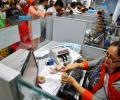
Major Indian banks, including Axis Bank, HDFC Bank, and RBL Bank, have reported a decline in employee headcount in FY26, attributing the reductions to significant investments in technology and automation yielding productivity gains across operations.
From the Sensex pack, Bajaj Finserv, Larsen & Toubro, Bajaj Finance, HDFC Bank, Bharat Electronics and Kotak Mahindra Bank were among the major laggards. However, Tata Steel, Asian Paints, UltraTech Cement, and Trent were the biggest gainers.

Vivo is bringing another 5G smartphone to Indian buyers, with the T5 5G set to go on sale from September 9. It will be sold through Flipkart.

Indian benchmark indices, Sensex and Nifty, closed almost unchanged due to profit-taking in blue-chip stocks, geopolitical uncertainties, fluctuating oil prices, and weak Asian market trends, despite cooling US inflation offering some support.
